Your internet speed is not your migration speed
You can have a symmetrical 1 Gbps internet connection and still watch a migration move at 15 Mb/s. In most cases, your internet connection is not the limiting factor. The limit is the API at one or both ends of the migration, and more bandwidth does not change that.
This is not specific to Liscaragh Migrate. Whether you use Liscaragh Migrate, ShareGate, Movebot, Microsoft's own migration tools or another migration product, they all communicate with the same source and destination APIs and are subject to the same platform limits. The difference is not whether throttling exists, but how each tool works within it.
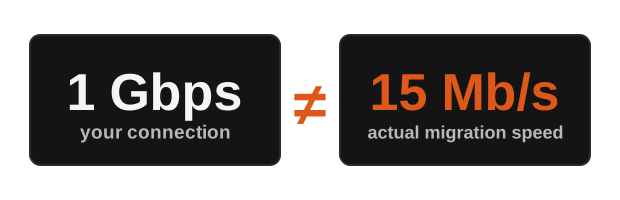
Bandwidth and migration throughput are different things
People often use speed to describe two different concepts.
- Bandwidth is the maximum capacity of your internet connection.
- Migration throughput is the rate at which data can actually move between the source and destination.
A migration is not one continuous stream of data. It consists of thousands or millions of API operations.
- List a folder
- Read file metadata
- Download a file
- Upload a file
- Confirm the upload
- Update permissions
Every request is processed by the service at the other end. Those services apply their own rate limits to protect their infrastructure, and those limits are completely independent of your internet connection.
If the source only allows a certain number of requests each second, that becomes the maximum rate your migration can achieve. A faster internet connection simply spends more time waiting for the next request to be accepted.
The source and destination have different priorities
The two ends of a migration do not behave in exactly the same way.
Microsoft 365 is designed to receive data. Microsoft publishes extensive migration guidance and automatically adjusts throttling based on service demand. During evenings and weekends there is often more capacity available for background migration activity. Microsoft also recommends app based authentication and asks customers planning migrations exceeding 100 TB within a month to notify them in advance.
Microsoft is equally clear that throttling exists to protect the service. It cannot be disabled by support, and opening a support case will not remove the limits. Good planning and following Microsoft's recommendations can improve performance, but they do not remove throttling altogether.
Source platforms are different.
Every platform has to protect its own API, and many publish very little information about their rate limits. Some simply return "slow down" responses when requests become too frequent. Others expose almost no information about how much capacity remains.
There are perfectly valid technical and commercial reasons for this. APIs consume infrastructure, and every provider needs to balance performance, stability and fairness across all customers. Whatever the reason, the practical outcome is the same. Your migration can only run as fast as the slowest API involved.
Adapts to throttling automatically
Liscaragh Migrate measures the source and destination's real throughput as it runs and adjusts its own pace accordingly, rather than hammering a fixed rate limit or needing manual tuning to stay within it.
What actually improves migration performance
Once the API becomes the limiting factor, adding bandwidth rarely improves performance.
Instead, focus on the factors you can influence.
- Run large migrations outside normal business hours where possible.
- Use app based authentication where supported.
- Avoid running multiple migration jobs through the same source account.
- Allow the migration tool to adapt to throttling instead of repeatedly hitting rate limits.
- Estimate project duration using measured migration throughput rather than internet bandwidth.
These changes generally have a far greater impact than upgrading an already fast internet connection.
Plan around the real bottleneck
Bandwidth matters, but only until it exceeds what the APIs can sustain.
After that point, every migration tool is working within the same platform limits. The difference is how effectively it detects throttling, adapts to changing conditions and makes the best use of the available capacity.
That is why Liscaragh Migrate measures the source platform's available rate during the migration and automatically adjusts its behaviour rather than relying on fixed assumptions or manual tuning.
Understanding where the real bottleneck lies leads to more realistic project planning, better expectations and smoother migrations.
If you would like to explore the subject further, see API throttling and bandwidth limits.